Overview
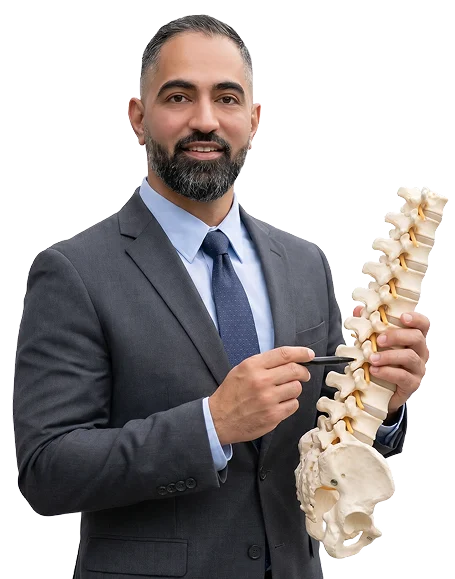
Back pain treatment starts with finding the likely source, because most back pain settles within weeks and the pain that lingers has many different causes. Dr Jawaad Malik, Consultant in Pain Medicine and an NHS consultant at Ashford and St Peter’s Hospitals, assesses persistent back pain and offers image-guided injections, non-surgical care alongside exercise and physiotherapy in Windsor, Woking, Wexham, Chertsey and Guildford.
| Question | Answer |
|---|---|
| Who is this for? | Adults with back pain that has lasted beyond a few weeks or keeps returning |
| Who will I see? | Dr Jawaad Malik, from consultation to follow-up |
| Which areas are assessed? | Lower, middle and upper back, buttock, tailbone and leg pain |
| Which treatments are offered? | Exercise-led plans, medicines review, injections, radiofrequency and referral |
| How are procedures done? | As day cases under local anaesthetic, with real-time imaging guidance |
| Where? | Private hospitals in Windsor, Woking, Wexham, Chertsey and Guildford |
What Is Specialist Back Pain Treatment?
It is care from a doctor trained in pain medicine for back pain that has not eased with time or first-line treatment. The NHS notes that back pain often improves within a few weeks and that a single cause is not always obvious.
Dr Malik uses a biopsychosocial approach: alongside the physical source, he asks about sleep, mood, work and activity. Injections are offered only when they fit the diagnosis, as one part of a wider plan.
Back Pain Red Flags: When to Get Urgent Help
| Your symptom | What it could mean | What to do |
|---|---|---|
| Numbness around the genitals, anus or inner thighs, or new bladder or bowel problems | Cauda equina syndrome (pressure on nerves at the base of the spine) | A&E or 999 now |
| Both legs weak, numb, tingling or painful | Possible serious spinal nerve problem | 999 or A&E |
| Chest pain with back pain, or pain after a serious accident | Heart problem, or injury to the spine | Call 999 |
| Feeling hot, shivery or unwell, or sudden severe pain that is worsening fast | Possible infection | Urgent GP appointment or NHS 111 |
| Unplanned weight loss, a lump in your back, or pain worse at night | A less common cause | See your GP |
Get a lift or an ambulance to A&E rather than driving. The NHS back pain guidance lists every warning sign. Read more about warning signs of back pain that need urgent attention.
Back Pain Conditions Dr Malik Assesses and Treats
Where the pain sits often hints at its source, so each region has its own page.
- Lower back: discs, facet joints and canal narrowing; see lower back pain treatment.
- Middle and upper back: pain between the shoulder blades or around the ribs; see thoracic spine pain.
- Buttock: the joint linking spine and pelvis; see sacroiliac joint pain.
- Tailbone: often worse when sitting; see coccydynia.
- Leg pain from the back: an irritated nerve root; see sciatica treatment.
Common causes he assesses include:
- Slipped or bulging disc: the cushion between two vertebrae bulges and may press on a nerve, though many cause no symptoms.
- Facet joint arthritis: wear in the small joints linking each vertebra.
- Spinal stenosis and degenerative disc disease: narrowing around nerves and age-related disc changes.
- Spondylolisthesis: a vertebra slips forward, most often low in the back.
- Muscle and ligament strain: a pulled muscle is a common cause.
- Persistent pain after spinal surgery: pain continuing after an operation.
How Dr Malik Finds the Source of Your Back Pain
A working diagnosis comes before any procedure:
- Your story: onset, spread and what eases or worsens it.
- Examination: spine examination, posture, movement and a neurological check of nerve function in the legs.
- Scans: he reviews existing MRI, CT or X-ray images; NICE advises new imaging only if it is likely to change management.
- Other causes: cancer, infection, trauma and inflammatory disease are excluded, as NICE recommends.
- Diagnostic block, if needed: numbing the nerves to a facet joint shows whether that joint is the pain source.
Treatment Options for Back Pain
Options run from self-management to procedures and, occasionally, a surgical opinion.
Exercise, Physiotherapy and Psychological Support
Staying active underpins every plan. NICE supports exercise programmes, with manual therapy only alongside exercise, and the NHS lists cognitive behavioural therapy (CBT) to help people cope with long-term pain.
Pain Medicines
Anti-inflammatory medicines (NSAIDs) may help where safe. NICE advises against opioids for chronic low back pain and gabapentinoids, so existing prescriptions are reviewed.
Epidural Steroid Injections
Steroid and local anaesthetic are placed near inflamed nerve roots. NICE suggests considering this for acute, severe sciatica, not back pain alone; see epidural injections.
Facet Joint Injections and Diagnostic Medial Branch Blocks
A medial branch block is a test: if numbing the nerves to a facet joint eases the pain, that joint is the likely source and radiofrequency denervation may be offered. See facet joint injections.
Radiofrequency Denervation
After a positive medial branch block, NICE supports considering radiofrequency denervation for moderate or severe chronic low back pain that non-surgical care has not helped. Heat stops small nerves sending pain signals; this usually provides 12–18 months pain reduction but may also not help in some selected patients.
Spinal Cord Stimulation
For nerve pain lasting at least 6 months despite usual care, NICE allows stimulation after specialist team assessment and a successful trial. Dr Malik assesses suitability and refers; see neuromodulation therapy.
When Surgery May Be Considered
Surgery is outside Dr Malik's practice. If a trapped nerve persists and scans match your symptoms, he refers you to a spinal surgeon.
Why Patients Choose Dr Malik for Back Pain Care
- The same doctor throughout: the consultant who examines you performs any procedure and reviews the result.
- Image-guided procedures: real-time imaging, local anaesthetic only, home the same day.
- Ultrasound credential: the World Institute of Pain has certified him as an Interventional Pain Sonologist (CIPS).
- Two NHS hospitals: he holds posts at Ashford and St Peter’s and, as honorary consultant, at St George’s in London.
- Reviews: patients’ verified feedback can be read on Doctify.
- Recognised expertise:
- Pain medicine fellowship of the Royal College of Anaesthetists’ faculty (FFPMRCA)
- Anaesthesia fellowship (FRCA) plus the European regional anaesthesia diploma (EDRA)
- In consultant practice since 2022
Meet Dr Jawaad Malik, Your Back Pain Consultant
His advanced fellowship years were spent at Charing Cross Hospital, where the focus was interventional techniques, neuromodulation and complex pain (Imperial school). He teaches on ultrasound and radiofrequency courses, has presented work on cancer pain neuromodulation service at the Royal Marsden, and consults in English, Hindi, Urdu and Punjabi.
What Happens at Your Back Pain Consultation
- Booking: self-pay patients book directly; insurers may want a GP referral first.
- What to bring: scans or reports, your medicines list and any insurance details.
- The consultation: around 30 minutes with Dr Malik covering your history, an examination and your imaging.
- Your plan: he explains the likely cause and the choices open to you, then writes to your GP.
- Follow-up: usually a 15-minute review of how things are going.
He sets out the benefits, risks and alternatives, including physiotherapy, medicines, psychological support or no procedure, so the decision is yours.
Injection Day, Recovery and Possible Side Effects
The skin is numbed and the needle guided by imaging; most people feel pressure rather than pain. Any soreness tends to fade over 24 to 48 hours, and light activity is often possible the same or following day. Steroid can take 24 to 72 hours to work, and NHS pain services advise not driving for 24 hours.
Side effects include bruising, a short-lived rise in pain, temporary numbness or leg weakness, headache, infection, bleeding and, rarely, nerve injury. People with diabetes should watch their sugar levels for two weeks, as steroid can push them up. Never stop blood thinners without advice.
Where Dr Malik Sees Patients With Back Pain
| Clinic | Address | Clinic times |
|---|---|---|
| The Princess Margaret Hospital | Osborne Road, Windsor SL4 3SJ | Tue 08:00–12:00 · Thu 18:45–20:00 · Sat 09:00–12:00 |
| Nuffield Health Woking Hospital | Shores Road, Woking GU21 4BY | Mon 14:00–18:00 · Wed 18:45–20:00 · Sat 09:00–13:00 |
| Spire Thames Valley Hospital | Wexham Street, Wexham, Buckinghamshire SL3 6NH | Mon 09:00–18:00 |
| The Runnymede Hospital | Guildford Road, Chertsey KT16 0RQ | Tue 14:00–17:30 |
| Mount Alvernia Hospital | Harvey Road, Guildford GU1 3LX | Thu 14:00–20:00, monthly |
Dr Malik confirms which hospital will host any procedure when you book. Out of hours, call NHS 111 for advice; the red flags above always mean 999.
Private or NHS Back Pain Care?
On the NHS, care usually starts with your GP, and in many areas you can refer yourself to community physiotherapy. Going private lets you pick the consultant and appointment time, often within days. Dr Malik works in both, including as an NHS consultant at Ashford and St Peter’s.
Back Pain Treatment Fees and Insurance
The practice puts your 2026 fee in writing before anything is booked.
| Appointment | Fee |
|---|---|
| Initial consultation | Stated in writing at booking |
| Follow-up | Stated in writing at booking |
| Image-guided injection or radiofrequency | Quoted after your consultation |
- Self-pay: no referral letter is needed.
- Insured: cover from most major private medical insurers is accepted; ask yours about limits and referral rules.
FAQs About Back Pain Treatment
What is the most effective treatment for chronic back pain?
It depends on the cause. Exercise and physiotherapy come first for most people; injections or radiofrequency denervation suit selected causes, such as confirmed facet joint pain, within a wider plan.
Do I need a scan before seeing a back pain specialist?
Usually not. NICE advises against routine imaging. Bring any MRI, CT or X-ray you already have, and Dr Malik will say whether another scan could change your treatment.
Are back injections painful?
Most people feel pressure and a brief sting from the numbing injection rather than sharp pain. Some soreness afterwards is common and tends to settle within a day or two.
How long do back pain injections last?
It varies. NHS leaflets say facet joint and epidural injections can ease pain for a few weeks or months, and some people notice little benefit; your own outlook depends on the diagnosis, which Dr Malik explains.
Can back pain be treated without surgery?
Most back pain is managed without an operation, through activity, physiotherapy, medicines and sometimes injections. A surgical opinion is considered if a trapped nerve does not improve.
What is the difference between upper and lower back pain?
Lower back pain arises in the lumbar spine, often from discs or facet joints. Upper and mid-back pain arises in the thoracic spine, where the ribs attach.
When is back pain an emergency?
Call 999 or go to A&E if back pain comes with numbness around the genitals or anus, bladder or bowel changes, weakness or tingling in both legs, chest pain, or follows a serious accident.
How much does private back pain treatment cost?
The total depends on the consultation, any scans and the procedure, and hospital charges differ between sites. Each figure is given in writing before you commit.
Will my insurance cover back pain treatment?
Most major private medical insurers are accepted, but limits and pre-authorisation rules differ. Ring your insurer before booking and ask whether they need a GP letter.
Can I book without a GP referral?
No, a self-funded appointment can be made directly, although some insurance policies ask for one. Either way, Dr Malik writes to your GP afterwards so your records stay joined up.