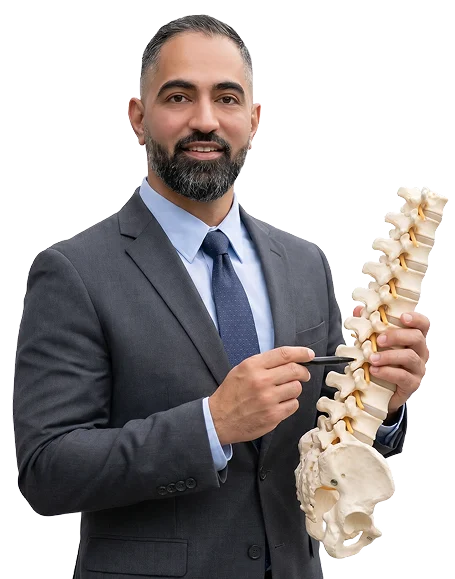
Overview
Knee pain treatment begins by finding which part of the knee is at fault: the joint surface, a meniscus, a tendon or a bursa. Dr Jawaad Malik, Consultant in Pain Medicine, checks the knee with ultrasound in clinic and may offer guided injections or genicular nerve radiofrequency treatment. He holds clinics in Windsor, Woking, Chertsey, Guildford and Wexham.
| Question | Answer |
|---|---|
| Who is this for? | Adults with knee arthritis, cartilage, tendon or bursa problems, or pain after a knee replacement |
| What happens first? | A knee history and examination, in-clinic ultrasound and a look at any X-ray or MRI |
| Which procedures are available? | Steroid injection, PRP, and a genicular nerve block that may lead to radiofrequency treatment |
| How are needles guided? | Ultrasound or X-ray (fluoroscopy) |
| Will I stay overnight? | No; procedures are day cases |
| Does Dr Malik operate on knees? | No; he refers to an orthopaedic surgeon if surgery is the better route |
What Is Non-Surgical Knee Pain Treatment?
It means easing knee pain without an operation: exercise and weight management first, then medicines, injections or nerve treatments where those are not enough. The NHS says knee pain can often be eased at home and should start improving within days; a specialist review helps when it does not.
Dr Malik’s examination checks your gait, the joint line, stability and range of movement, and the scan shows fluid, a thickened bursa or an irritated tendon there and then. That shows which structure to target.
When Does Knee Pain Need Urgent Help?
| What you notice | Possible reason | Where to go |
|---|---|---|
| Severe pain after a fall or twist, or the knee cannot take any weight | Fracture or major ligament injury | A&E or 999 |
| Kneecap has shifted out of place after a collision or sudden turn | Dislocated kneecap | A&E or 999 |
| Red, hot knee and you feel feverish or shivery | Infection inside the joint | NHS 111 now |
| Badly swollen or misshapen knee, or one that locks or gives way | Torn cartilage, ligament or tendon | NHS 111, or an urgent treatment centre (minor injuries unit) |
| Pain that has not improved within a few weeks | Arthritis, meniscus or tendon problem | GP or specialist assessment |
The NHS advice on knee pain adds that painless clicking is normal. If you take anticoagulants, swelling with warmth and bruising can mean bleeding into the joint and needs prompt advice.
Knee Problems Dr Malik Assesses
- Knee osteoarthritis: stiffness and aching that is often worst on stairs or slopes; over time both knees are usually affected.
- Patellofemoral pain (runner's knee): discomfort around or behind the kneecap, typically after running, squatting or long sitting.
- Meniscal tears or wear: damage to the knee's cartilage cushions, causing catching, locking or giving way.
- Patellar tendinopathy (jumper's knee): pain between the kneecap and shin after repeated running or jumping.
- Prepatellar and infrapatellar bursitis: a warm, swollen bursa in front of or below the kneecap, worse with kneeling.
- Collateral ligament sprains (MCL, LCL): overstretched ligaments on the inner or outer side of the knee.
- Baker's cyst: a fluid-filled swelling behind the knee.
- Pain after knee surgery: including pain that persists after a knee replacement.
Hip pain has its own hip pain treatment page, and pain in several joints is covered under joint pain treatment.
Knee Pain Treatment Options
Most people start with the first two options below.
Strengthening Exercise and Weight Management
National guidance recommends tailored exercise for everyone with knee osteoarthritis, sometimes supervised, plus weight loss if you are overweight. These are the foundation that every other option is meant to support. Results take weeks of regular effort.
Gels, Tablets and Other Medicines
National guidance advises offering an anti-inflammatory (NSAID) gel for knee osteoarthritis before tablets, and not routinely offering paracetamol or weak opioids. Tablets carry stomach, kidney and heart risks, so they are used at the lowest dose for the shortest time.
Corticosteroid Knee Injection
A steroid with local anaesthetic is injected into the knee joint or an inflamed bursa under ultrasound. It may calm a flare enough to restart exercise. National guidance describes the relief in osteoarthritis as short term, typically 2 to 10 weeks. More on the steroid injections page.
Genicular Nerve Block and Radiofrequency Treatment
The genicular nerves carry pain signals from the knee. First, a diagnostic block numbs them with local anaesthetic to see whether your pain eases. If it clearly helps, radiofrequency treatment heats the same nerves to interrupt those signals for longer. There is good evidence of short-term pain relief and no major safety concerns, provided the clinician has specific training.
PRP Injection
Platelet-rich plasma is prepared from your own blood and injected into the knee. The evidence is limited in quality and national guidance suggests extra governance, consent and audit whenever it is used. Further detail: regenerative orthopaedics.
Hyaluronic Acid (Viscosupplementation)
This joint-lubricant injection is listed on Dr Malik's site, but national guidance recommends it is not offered routinely for osteoarthritis.
Knee Surgery and Orthopaedic Referral
Where pain and stiffness seriously affect daily life despite non-surgical care, national guidance suggests considering knee replacement, and Dr Malik refers you to an orthopaedic surgeon for further assessment.
Pain After a Knee Replacement
Some people still have pain months after a knee replacement. Dr Malik first asks that your surgeon has checked for infection or a loose implant. If those are excluded, he reviews your medicines and rehabilitation and discusses whether a diagnostic genicular nerve block is worth trying.
Why People See Dr Malik About Knee Pain
- Scan and treat in one place: the knee is examined and scanned at the consultation, and procedures are image-guided.
- Nerve-focused options: genicular nerve block and radiofrequency treatment for arthritic knees.
- Honest referral: if a new joint would help more, he says so and refers you.
- Recognised expertise:
- Consultant in Pain Medicine, Ashford and St Peter’s Hospitals; Honorary Consultant, St George’s Hospital
- CIPS (World Institute of Pain), FFPMRCA, FRCA, EDRA
- Patient reviews published on Doctify
What Happens at a Knee Pain Appointment
- Your story: when the pain began, what aggravates it and what has been tried.
- Examination: walking, joint line tenderness, stability and how far the knee bends and straightens.
- Ultrasound: fluid, bursae, tendons and the joint margins are checked in the room.
- Imaging: any X-ray or MRI is reviewed, or requested if it would help.
- Decision: the options, risks and alternatives, including physiotherapy or no procedure, are discussed before anything is agreed.
On the Day of a Knee Procedure
Bring your medicines list and arrange a lift home. The skin is cleaned and numbed. For a genicular nerve procedure, several needles are placed around the knee under X-ray or ultrasound; you may be asked whether you feel a tingle before each nerve is heated for about a minute.
Recovery and Risks After Knee Procedures
Most people walk out the same day, and soreness after an injection usually eases within 24–48 hours. After radiofrequency treatment, the knee may be more uncomfortable for up to three weeks before relief begins.
- After a steroid injection: a temporary flare in about 1 in 10 people, a few days of higher blood sugar in diabetes, and rarely infection.
- After radiofrequency treatment: temporary numbness around the knee, bruising or infection; rarely, lasting numbness, weakness or more pain.
- How long relief lasts: can last up to 2 years for some people, but it does not help everyone.
Seek same-day advice if the knee becomes hot, red and increasingly painful, or you develop a fever.
Knee Clinics in Windsor, Woking, Chertsey, Guildford and Wexham
| Hospital | Where it is | When Dr Malik is there |
|---|---|---|
| The Princess Margaret Hospital | Osborne Road, Windsor SL4 3SJ | Tuesdays 8am–12pm, Thursdays 6:45pm–8pm and Saturdays 9am–12pm |
| Nuffield Health Woking Hospital | Shores Road, Woking GU21 4BY | Mondays 2pm–6pm, Wednesdays 6:45pm–8pm and Saturdays 9am–1pm |
| Spire Thames Valley Hospital | Wexham Street, Wexham SL3 6NH | Mondays 9am–6pm |
| The Runnymede Hospital | Guildford Road, Chertsey KT16 0RQ | Tuesdays 2pm–5:30pm |
| Mount Alvernia Hospital | Harvey Road, Guildford GU1 3LX | One Thursday a month, 2pm–8pm |
Appointments are often available within days. Where your procedure takes place is agreed at booking (clinic details). For urgent problems when the office is closed, use NHS 111 or, in an emergency, 999.
Private Knee Pain Treatment: Cost and Insurance
The practice does not list prices on the website; you receive each 2026 fee in writing and can decide before committing.
| Service | Fee |
|---|---|
| Knee consultation and ultrasound | Confirmed in writing before booking |
| Steroid or PRP injection | Quoted after your consultation |
| Genicular nerve block, then radiofrequency | Quoted after your consultation |
- Self-funding: no GP referral is needed.
- Health insurance: accepted by most major insurers; ask yours whether nerve procedures and PRP are covered.
FAQs About Knee Pain and Knee Injections
Which injection is best for knee arthritis?
None suits everyone. A steroid can settle a painful flare for a few weeks, a genicular nerve procedure targets longer-standing arthritic pain, and PRP is backed by limited evidence. Dr Malik matches the choice to your scan and goals.
How long does a knee steroid injection last?
Typical range of 2 to 10 weeks for knee osteoarthritis. Some people notice a benefit for longer, others hardly at all, which is why the injection is usually paired with an exercise plan.
What is genicular nerve radiofrequency ablation?
It is a day-case procedure that heats the small sensory nerves around the knee to reduce the pain signals they send. It follows a test block that numbs the same nerves, and it does not change the joint itself.
Can injections help me avoid a knee replacement?
They may ease symptoms and let some people put surgery off, but no injection can promise that. If your knee keeps limiting daily life, a surgical opinion is a reasonable next step.
Is PRP effective for knee osteoarthritis?
The evidence is still limited. National guidance raised no major safety concerns but asks that PRP is given only with careful consent and audit. Dr Malik will explain the uncertainty before you decide.
Does a knee injection hurt?
Expect a sting from the local anaesthetic, then a pushing sensation. Positioning the needles for a genicular nerve procedure can be uncomfortable, and the knee may ache for a few days afterwards.
How soon can I walk and drive after a knee injection?
You can walk straight away. Avoid driving for 24 hours after local anaesthetic, and arrange a lift home after a genicular nerve procedure. Strenuous exercise is best avoided for a few days.
How many knee injections can I have?
Steroid injections are spaced out because repeated doses can weaken tendons and ligaments. Dr Malik reviews how much each one helped before suggesting another and will discuss a sensible limit for your knee.
Do I need a GP referral or an MRI first?
Neither is essential for a self-funded appointment. Bring any scans you already have; Dr Malik can arrange imaging if it would change the plan. Insured patients should check whether their policy needs a referral.
Is knee pain treatment covered by private health insurance?
Dr Malik works with most major insurers, but cover for PRP and radiofrequency procedures varies between policies. Ask your insurer to authorise the procedure first and check whether a GP referral is needed.